
Bingo or Slots? This Comparison Will Change How You Gamble Forever!
Bingo or Slots? This Comparison Will Change How You Gamble Forever!
Online Bingo Vs Online Slots: Choosing Your Digital Gaming Adventure
Online bingo and online slots are two of the main choices for digital gaming. Bingo is built around community play, while slots are designed for solo sessions. Knowing the key differences between these games helps players, operators, and platform providers make better decisions about which games to offer or play, how to keep players engaged, and how to support responsible gaming. This guide looks at how online bingo and slots differ in gameplay, payouts, social features, and who plays them. The goal isn't to say which is better, but to help you choose the game that fits your style, budget, and what you want from your gaming experience.
How Online Bingo Works
Online bingo is played in rounds. You buy tickets with number grids, and a random number generator calls out numbers one by one. You win by matching numbers to make certain patterns, like a single line, multiple lines, or a full house.
Bingo games run on a schedule, starting at set times and using shared prize pools. The main types are 90-ball (the UK style), 75-ball (popular in North America), and speed bingo (30-ball or other fast formats). Each has its own grid layout and pace.
Most online bingo sites offer chat rooms, themed games, side games, and sometimes progressive jackpots. The main action is passive: you watch as numbers are drawn. Some sites let you buy more tickets during a game or join mini-games in the chat between rounds.
How Online Slots Work
Online slots offer instant, on-demand play with spinning reels filled with symbols. You choose your bet, spin the reels, and see the results right away thanks to random number generators. You win when matching symbols line up on paylines, and payouts depend on the symbols and your bet size.
Slots have changed a lot from the old 3-reel machines. Now, many games have 5 or more reels, hundreds of paylines, cluster pays, cascading symbols, expanding wilds, multipliers, free spins, and bonus rounds. Themes cover everything from classic fruit machines to movies, myths, adventures, and more.
Slots are available anytime, with no schedule. Each spin is independent, and you control the pace. You can use autoplay for continuous spins, but most sites set limits to encourage responsible play.
Slot game fairness and RNG integrity are independently tested by accredited laboratories such as eCOGRA and iTech Labs.
Gameplay Speed And Complexity Comparison
The speed of online bingo and slots affects how players experience the games and how quickly they spend money.
Bingo moves at a steady pace, even in faster versions. There are pauses between number calls, giving you time to check your cards or chat. A 90-ball game usually takes 3 to 5 minutes, and you always know when the next game starts. This setup gives you clear session times and natural breaks.
Slots are much faster. You can spin dozens of times a minute, especially with autoplay. This means you can spend your balance much quicker than in bingo, so it's important to keep an eye on your budget.
The complexity of these games also differs. Bingo rules are mostly the same across versions, so it's easy to learn. Slots can be simple or very complex, with features like scatters, wilds, bonus rounds, and more. This variety is fun but can be confusing for new players.
RTP, Volatility, And Financial Design
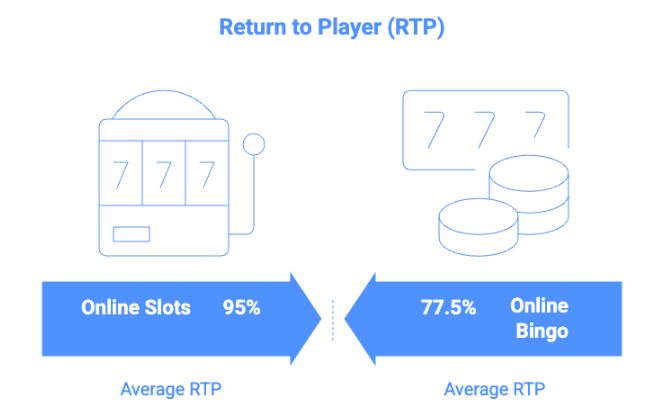
Return to player (RTP) and volatility represent critical financial characteristics that distinguish these formats.
According to guidance published by the UK Gambling Commission, RTP figures represent theoretical long-term averages calculated over extensive gameplay, rather than guarantees of short-term outcomes.
Online bingo typically exhibits RTPs between 70% and 85%, depending on game variant, ticket pricing structures, and prize pool allocation. The lower end reflects the pooled prize model and operator margins required for scheduled games with guaranteed prize funds. Some promotional games or special events may offer higher RTPs, whereas community jackpot contributions may reduce base-game returns.
Online slots generally show higher RTP figures, typically ranging from 93% to 97%, with many commercial releases clustering around 95% to 96%. However, considerable variation exists. Classic slots typically range from 92% to 94%, whereas some feature-rich games exceed 96%. Branded titles and progressive jackpot slots often display lower base RTPs due to the funding of jackpots.
A higher RTP does not guarantee increased winnings within a single session. Volatility, which refers to the frequency and magnitude of payouts, is equally significant.
Slots may exhibit low or high volatility. Low-volatility slots provide frequent, smaller payouts, resulting in gradual balance fluctuations. High-volatility slots offer less frequent but larger wins, which can lead to rapid balance depletion or substantial gains within a short period.
Bingo demonstrates steadier volatility. Prize pools are distributed across multiple pattern completions (first line, second line, full house), creating incremental win opportunities. The community prize structure means even non-winning tickets contribute to a shared experience rather than isolated losses.
Neither format offers predictable session outcomes. Both are designed with house edges ensuring long-term operator profitability. Players should treat both as entertainment expenditures rather than investment opportunities.
Social Interaction Versus Solo Play
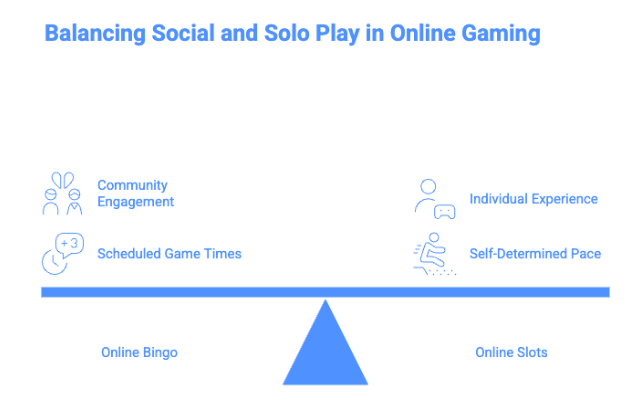
The social dimension is one of the clearest distinctions between online bingo and online slots.
Online bingo platforms emphasise community engagement. Most games includeOnline bingo is all about community. Most games have chat rooms with hosts who keep things lively, announce winners, and run activities between games. Regular players get to know each other, just like in a real bingo hall. Some sites even have team games or community jackpots that everyone works toward together, while others let you interact with game mechanics and themes independently, with gameplay progressing at a self-determined pace. While some platforms offer tournaments or leaderboard-based features, the core slot experience remains single-player focused, appealing to those seeking private, on-demand entertainment across different contexts.
There's no right or wrong choice. Some people like the social side of bingo, while others prefer the solo play of slots. It all comes down to what you enjoy most.
Skill, Luck, And Common Misconceptions
Both online bingo and online slots are fundamentally chance-based games. Outcomes are determined by RNG systems certified by regulatory authorities and independent testing laboratories. No strategy, system, or skill can alter these probability-driven results.
Slots' outcomes are entirely random per spin. Previous results do not influence future spins. Machines do not run "hot" or "cold." Bonus features trigger based on probability, not accumulated play. Common misconceptions include beliefs that betting patterns, timing, or prolonged play increase win likelihood - none of these factors affect RNG-determined outcomes.
Bingo introduces minor engagement elements but remains luck-dependent. Players may exercise limited choices: selecting which tickets to purchase, how many to buy per game, or which game rooms to enter. Some players track numbers or employ card-selection preferences based on number-distribution theories. These activities provide engagement but do not influence the random number draw or alter fundamental odds.
The critical distinction is that bingo allows purchasing multiple tickets per game, increasing the probability of matching called numbers. However, this scales cost proportionally and does not change the house edge or expected return per unit wagered.
Both formats should be understood as entertainment services with negative expected values over time. Players paying for the experience rather than expecting profit maintain healthier engagement patterns.
Variety, Themes, And Innovation Trends
Online slots dominate in thematic diversity and mechanical innovation. Game studios release hundreds of titles annually, exploring every conceivable theme through advanced graphics, animations, soundtracks, and narrative elements. Mechanical innovations include megaways (variable reel structures offering thousands of paylines), cluster pays, cascading reels, expanding game boards, and increasingly complex bonus structures.
This huge variety keeps players interested and brings in new ones. Slots based on movies, TV, music, and sports are especially popular with casual players.
Online bingo demonstrates more constrained but meaningful innovation. Themed rooms apply cosmetic variations to core mechanics - seasonal events, licensed properties, or interest-based communities. Side bets, special pattern games, and hybrid formats (combining bingo with slot mechanics, such as Slingo variants) add variety while maintaining fundamental bingo structure.
Speed bingo addresses pacing preferences, while 80-ball and 30-ball variants offer middle-ground options between traditional formats. Progressive community jackpots and multi-game prizes create additional layers of engagement without fundamentally altering gameplay.
For operators, slots require continuous content investment but offer broader appeal mechanisms. Bingo relies on community-building and scheduled-event structures that create habitual engagement patterns.
Player Demographics And Cross-Over Behaviour
Knowing who plays bingo or slots, and why, helps sites choose the right games and how to market them.
Many bingo players who move online look for the same community feel and familiar games they know from bingo halls. They like chat features and set game times that help build a routine. But online bingo now attracts a much wider range of players than the old bingo hall crowd.
Today's online bingo brings in all kinds of players who want social, low-stakes fun. Mobile bingo is great for people who want to play casually or while doing other things.
Slot players usually want great visuals, lots of themes, and the freedom to play at their own pace. Slots are perfect for solo, mobile play and let you choose your bet size, whether you're playing for fun or for bigger stakes.
Many players now switch between bingo and slots. Bingo fans often play slots between games, and slot players try bingo for a slower pace or more social features.
Platform data suggests player preference increasingly outweighs demographic predictors. Age, gender, and background correlate less strongly with game choice than factors like desired pace, social preference, budget approach, and session length. Modern players sample across formats based on mood, context, and specific entertainment goals rather than rigid format loyalty.Operators benefit from recognising this fluidity by offering integrated experiences rather than siloed game categories. Cross-promotion between formats, unified loyalty programmes, and lobby designs facilitating format exploration serve evolving player behaviours.
Decision Guidance: Which Game Suits Which Player
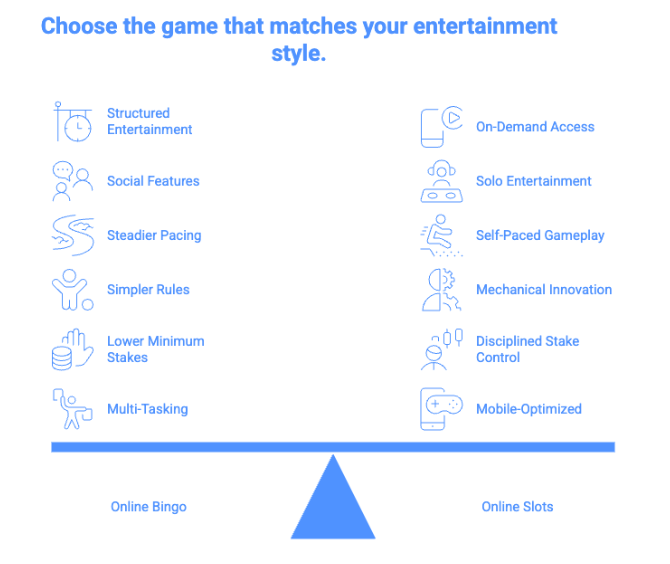
Rather than declaring one format superior, matching player preferences to format characteristics produces more satisfying outcomes.
Online bingo may better suit players who:
- Prefer structured, scheduled entertainment over on-demand play
- Value social features and community interaction
- Appreciate steadier pacing with natural breaks between games
- Seek simpler rule sets requiring minimal learning investment
- Prefer lower minimum stakes and incremental prize opportunities
- Enjoy multi-tasking during gameplay (bingo's passive nature accommodates this)
Online slots may better suit players who:
- Want immediate, on-demand access without schedule constraints
- Prefer solo entertainment without social obligations
- Appreciate visual variety, thematic diversity, and mechanical innovation
- Enjoy exploring different game mechanics and bonus features
- Favour self-paced gameplay with complete session length control
- Seek mobile-optimised entertainment for varied contexts
Players interested in both formats may explore integrated platforms or hybrid games offering crossover experiences.
Budget and time availability matter. Bingo's slower pace may stretch entertainment budgets and suits predictable schedules, while slots require disciplined stake control but fit irregular or shorter sessions. Neither format offers better odds; entertainment style, pace, and social preference are the more relevant decision factors.
Conclusion
Bingo and slots each offer something different. Bingo is about scheduled games, community, and simple rules. Slots are for solo play, instant action, and lots of themes and features.
Slots usually have higher RTPs but also higher volatility and faster spending. Bingo has lower RTPs but steadier payouts and a slower pace. Both are games of chance, so there's no real strategy edge.
Player behaviour is increasingly fluid, with users moving between formats based on context rather than loyalty. Choosing between bingo and slots depends on personal preferences around pace, social interaction, themes, budget control, and session length, supporting informed and responsible play.
FAQ
Which has better odds: online bingo or online slots?
Usually, online slots return between 93% and 97% to players, whereas digital bingo tends to give back only 70% up to 85%. Still, these percentages reflect what happens on average after vast numbers of plays, not short bursts of gameplay. With slots, swings in account totals tend to be sharper - larger drops or gains appear more often. Outcomes cannot be foreseen in either game type, since randomness defines each result. Over extended periods, the built-in advantage favors the provider consistently.
Which game is more social: bingo or slots?
Community focus defines online bingo, where chat rooms appear alongside live hosts, group rewards emerge, while games run at once, fostering joint moments. In contrast, slots serve one person mostly, yet certain sites introduce contests, ranking boards, or progress markers. Those wanting connection during play often see bingo fitting their style more closely.
Are online bingo and slots games fair
Certified random number generators (RNGs) appear on licensed gambling platforms, verified through outside labs as required by official bodies. Under UK rules, the Gambling Commission applies firm guidelines to ensure balanced play. Outcomes in digital bingo and slot games unfold without pattern, unaffected by prior results or user behavior. Before sending money, check whether a site holds valid authorization and active supervision.
Can I use strategies to win at bingo or slots?
Outcome manipulation remains impossible regardless of approach. Chance defines both experiences at their core. More cards in a single bingo round raise winning odds slightly - yet expenses grow just as fast, leaving value unchanged. Slot results stay unaffected by when or how much one wagers. Extended sessions bring no advantage. Financial discipline stands alone as effective oversight.